Not Every Emotion Is a Trigger

Not Every Emotion Is a Trigger
Learning the difference might be the most freeing thing you ever do.
There’s a moment most people don’t realize they’re living in…
Where everything feels like a trigger.
Someone says something → trigger.
You feel irritated → trigger.
You want to pull away → trigger.
You feel sad, overwhelmed, off → must be a trigger.
And suddenly…
you’re walking through life like it’s one big emotional minefield.
But here’s the truth:
Not every emotion is a trigger.
And confusing the two will keep you stuck longer than the emotion itself.
Let’s Get Clear
A Feeling / Emotion is:
A natural, present-moment response.
It’s your body saying:
“Hey… something is happening inside me right now.”
Sadness.
Frustration.
Joy.
Disappointment.
Loneliness.
Peace.
Emotions are information, not problems.
They move.
They shift.
They pass—if you let them.
A Trigger is:
An emotional reaction that’s bigger than the moment you’re in.
It’s not just about what’s happening now…
it’s about what it reminds you of.
A trigger pulls from the past and drops it into your present.
Suddenly:
Your reaction feels intense
Your body tightens
Your thoughts speed up
You feel the need to defend, shut down, or escape
And most of the time…
It doesn’t match the situation in front of you.
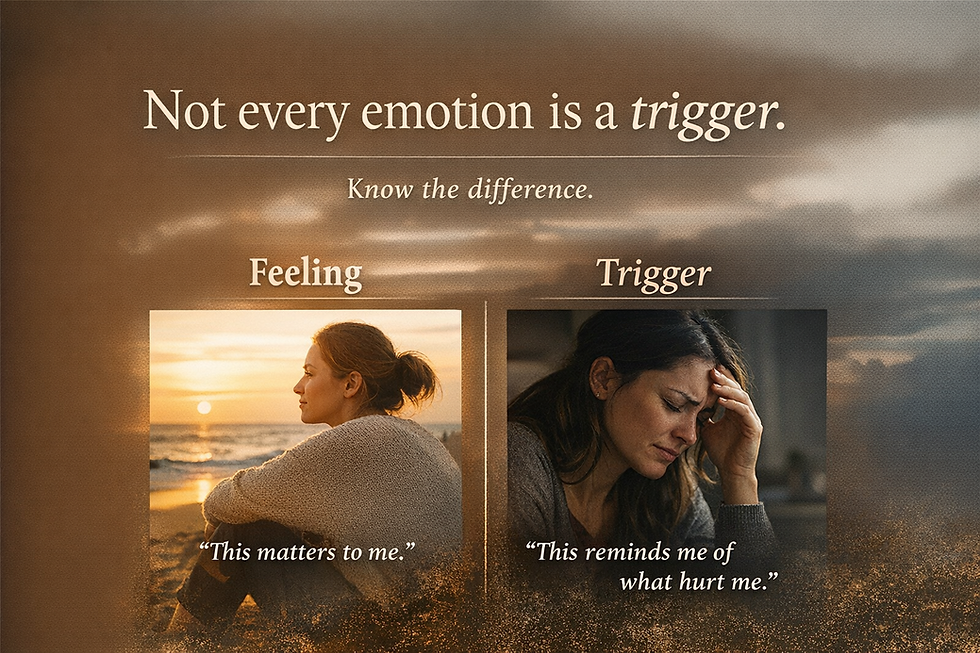
The Difference
A feeling says:
“This matters to me.”
A trigger says:
“This reminds me of something that once hurt me.”
Let’s Ground This in Real Life
You text someone… they don’t respond.
Feeling:
“I feel a little disappointed.”
→ You notice it
→ You let it move
→ You stay grounded
Trigger:
“They’re ignoring me. I’m not important.”
→ Your chest tightens
→ Your mind starts building a story
→ You want to react, withdraw, or protect yourself
The situation is the same.
The internal experience is not.
Here’s Where People Get Stuck
We’ve been taught to:
Label everything as a trigger
Or dismiss everything as “just a feeling”
So we either:
Overreact to normal emotions
or
Underreact to deeper wounds that need attention
And neither one creates healing.
What This Looks Like in Your Body
This is where your work is so powerful, Laurie—because this isn’t just mindset… it’s physical.
A feeling:
Comes in waves
You can stay present
You can name it without spiraling
A trigger:
Hits fast
Feels urgent
Tight chest, headache, nausea, tension
Your body says: “Something’s not safe” (even if you are)
That moment you described—
where your body tightens, your head hurts, you feel like you might throw up…
That’s not “just a feeling.”
That’s your nervous system saying:
“We’ve been here before.”
The Work Is Not to Eliminate Either
This is where most people get it wrong.
You don’t:
“Fix” feelings
“Shut down” triggers
Or try to become unbothered
That’s emotional resistance dressed up as growth.
The Work Is to Respond Differently
With a feeling:
Let it move.
“I feel this… and I’m okay.”
No story.
No overthinking.
Just presence.
With a trigger:
Slow it down.
“This feels bigger than right now… what is this connected to?”
Not to dig up the past in chaos—
but to create awareness instead of reaction.
A Simple Check-In
Next time something hits, ask:
Is my reaction matching the moment?
Is my body calm or activated?
Am I responding… or protecting?
That’s it.
No overcomplicating.
Here’s the Truth Most People Avoid
Not everything that feels uncomfortable is a wound.
And not everything that feels intense is about the present.
Learning the difference…
That’s emotional resilience.
Your Steady Ground Moment
You don’t need to:
fear your emotions
or label every hard moment as a trigger
You just need to learn how to tell the difference.
Because when you do…
You stop reacting to everything
…and start understanding yourself instead.
If this hit a little deeper than expected…
that’s usually where the real work begins.
And you don’t have to figure it out alone.


Comments